Diabetic Wound Won't Heal? When Home Care Isn't Enough
Dr. David Reyes, a board-certified wound care specialist, explains why diabetic wounds fail to heal, when home treatment has reached its limit, and how specialist intervention at Moses Medical can prevent amputations.

Dr. David Reyes · Wound Care
July 15, 2026
In the Bronx, diabetes is not rare — it is an epidemic. Nearly 16% of adults in the borough have been diagnosed with diabetes, one of the highest rates in the country. And for a significant number of those patients, the most dangerous complication is not a heart attack or kidney failure. It is a wound that will not heal.
Diabetic foot ulcers affect approximately 15% of people with diabetes at some point in their lives. Of those, roughly 14-24% will eventually require an amputation. That is not a distant statistical risk. In the neighborhoods surrounding Moses Medical — Longwood, Hunts Point, Morrisania — I see patients every week who came in too late because they did not know when home care had stopped being enough.
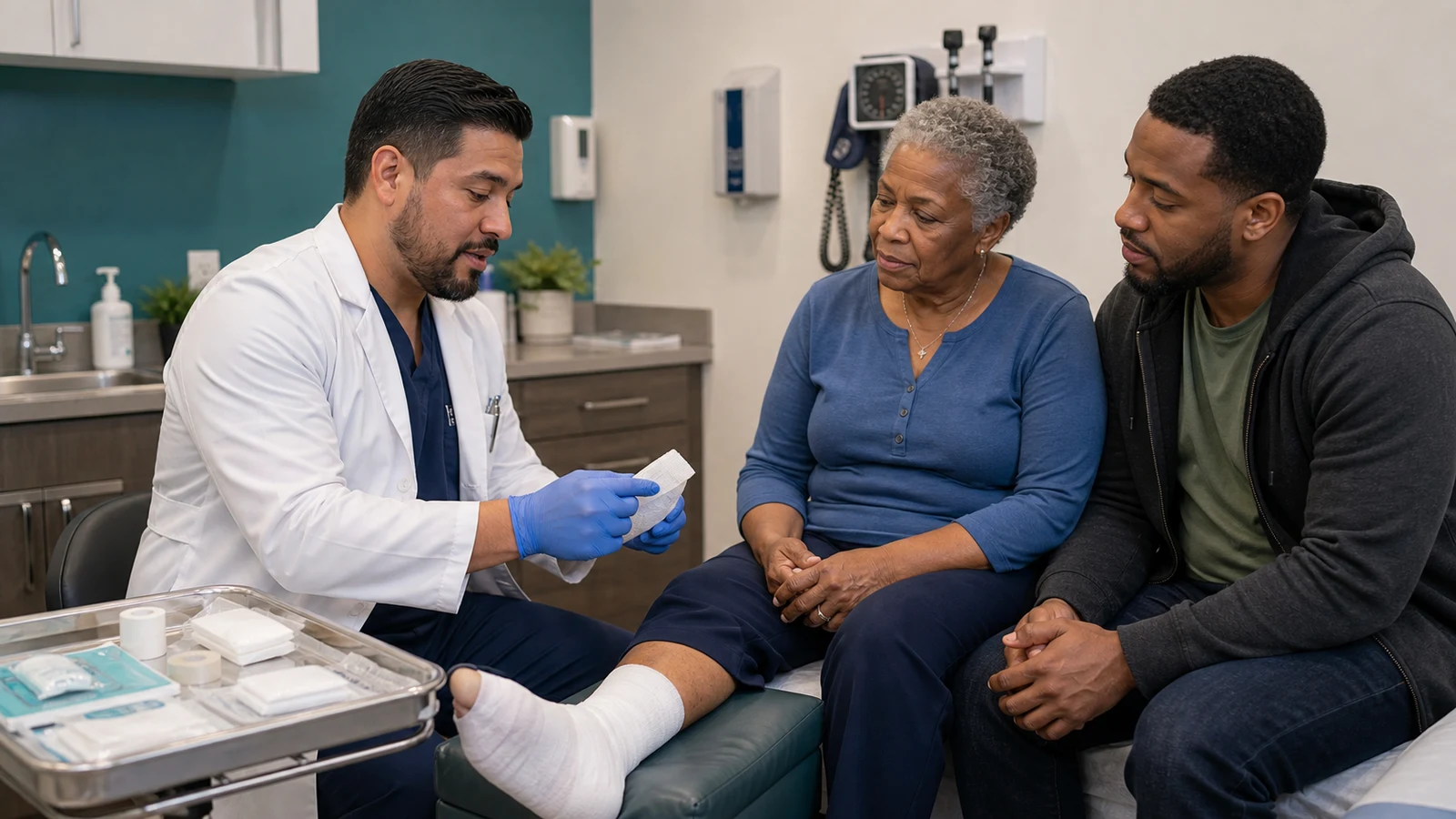
I’m Dr. David Reyes, a board-certified wound care specialist at Moses Medical. I earned my medical degree at the University of Puerto Rico School of Medicine and completed my residency in internal medicine at Lincoln Medical Center, right here in the Bronx. I pursued advanced certification in wound management because I was tired of seeing preventable amputations in the community I serve. Bilingual in English and Spanish, I work with patients and their families to catch problems early and heal wounds before they become emergencies.
Why Diabetic Wounds Don’t Heal
To understand why a simple cut, blister, or pressure sore can become life-threatening for someone with diabetes, you need to understand what diabetes does to your body over time:
Neuropathy (nerve damage). High blood sugar damages the small nerves in your feet and legs, reducing sensation. You may not feel a pebble in your shoe, a blister from ill-fitting footwear, or a cut on the sole of your foot. By the time you notice the wound, it may have already become infected.
Poor circulation (peripheral arterial disease). Diabetes damages blood vessels, reducing blood flow to the extremities. Blood carries oxygen, nutrients, and immune cells — all essential for healing. Without adequate circulation, even a small wound can stall.
Immune dysfunction. Diabetes impairs your immune system’s ability to fight infection. A wound that would take a week to heal in a healthy person can become a breeding ground for bacteria in a diabetic patient, escalating from superficial to deep tissue infection rapidly.
Hyperglycemia. Elevated blood sugar directly impedes wound healing at the cellular level. If your blood sugar is consistently above 200 mg/dL, your body’s repair mechanisms are working at a fraction of their capacity.
When Home Care Is No Longer Enough
Many patients try to manage wounds at home — and in some cases, basic wound care is appropriate. Cleaning a minor cut, applying antibiotic ointment, and covering it with a bandage is reasonable for small, superficial injuries.
But you need to see a wound care specialist if:
- A wound has not shown improvement after two weeks of home care
- The wound is getting larger, deeper, or more painful
- You see signs of infection: increasing redness, warmth, swelling, drainage (especially if it is yellow, green, or foul-smelling), or red streaks spreading from the wound
- You have a fever along with a wound
- The wound is on your foot and you have diabetes — even if it looks minor
- You can see bone, tendon, or deep tissue in the wound
- The area around the wound is turning black (necrotic tissue)
- You have already had an amputation and have a new wound on your remaining limb
Do not wait. The difference between a wound that heals and a wound that leads to amputation is often a matter of weeks. Early specialist intervention changes outcomes.
What Specialist Wound Care Looks Like
When you come to Moses Medical for wound care, here is what to expect:
Assessment
I begin with a thorough evaluation of the wound itself: location, size, depth, tissue quality, and signs of infection. But I also evaluate the whole patient:
- Circulation assessment — checking pulses in your feet and legs, and referring for vascular studies if blood flow appears compromised. For skin conditions that may complicate wound healing, our dermatologist provides expert evaluation for Bronx families with all skin types.
- Sensation testing — using monofilament testing to assess nerve function
- Lab work — through our on-site lab, we check your HbA1c (long-term blood sugar control), complete blood count (to assess for systemic infection), metabolic panel, and albumin (a marker of nutritional status that directly affects healing)
- Medication review — certain medications can impair wound healing, and we need to know everything you are taking
Treatment
Wound care is not one-size-fits-all. Depending on your wound, treatment may include:
- Debridement — removing dead, damaged, or infected tissue from the wound bed to promote healthy tissue growth. This is done in the office under local anesthesia when needed.
- Advanced dressings — specialized wound dressings that maintain a moist healing environment, manage drainage, and deliver antimicrobial agents directly to the wound.
- Offloading — redistributing pressure away from the wound site. For foot ulcers, this may involve specialized shoes, boots, or orthotic devices. A wound will not heal if you keep walking on it without protection.
- Compression therapy — for wounds associated with venous insufficiency (poor blood return from the legs), compression bandaging or stockings promote circulation and reduce swelling.
- Infection management — oral or IV antibiotics when infection is present. Wound cultures guide antibiotic selection to ensure we target the right organisms.
- Blood sugar optimization — coordinating with your primary care provider or endocrinologist, such as Dr. Aisha Williams, to bring your glucose under control. No wound treatment will succeed if your blood sugar remains uncontrolled. Dr. Williams also offers pharmacogenomic testing that can determine whether your diabetes medications are optimally matched to your genetic profile.
Coordination with Your Care Team
At Moses Medical, wound care does not happen in isolation. I coordinate directly with our internal medicine and primary care teams to address the systemic conditions that caused the wound in the first place. Patients with diabetes and wound complications often have undiagnosed heart disease. If you also have high blood pressure, consider a cardiology evaluation. If you need vascular evaluation, podiatric care, or surgical consultation, I facilitate those referrals through our hospital partners at St. Barnabas Hospital, Lincoln Medical Center, and Jacobi Medical Center.
Amputation Prevention: The Real Goal
Let me be blunt: the goal of our wound care program is not just to heal the wound in front of us. It is to keep you out of the operating room.
Lower-extremity amputations in diabetic patients are one of the most devastating — and most preventable — outcomes in medicine. Studies consistently show that specialized wound care reduces amputation rates by 50-85% compared to standard primary care management alone.
What makes the difference:
- Earlier intervention — catching wounds before they progress to deep infection or bone involvement
- Evidence-based protocols — using treatments backed by clinical data, not outdated practices
- Regular follow-up — monitoring healing progress weekly or biweekly and adjusting the plan
- Patient and family education — teaching you and your caregivers how to inspect your feet daily, recognize warning signs, choose proper footwear, and manage your blood sugar
Preventing the Next Wound
Once a wound heals, the work does not stop. Patients with diabetes who have had one foot ulcer have a 40% chance of developing another within a year and a 65% chance within five years. Prevention is an ongoing practice:
- Daily foot inspection — look at every surface of both feet daily, using a mirror for the soles
- Proper footwear — never go barefoot, avoid shoes that pinch or rub, and consider diabetic shoes if recommended
- Nail care — trim nails straight across and avoid cutting into corners
- Blood sugar control — the single most important factor in preventing future wounds
- Regular provider visits — have your feet examined at every primary care and wound care appointment
Do Not Wait Until It Is an Emergency
If you or a family member has diabetes and a wound that is not improving, the safest thing you can do is have it evaluated by a specialist. Not next month. This week.
Moses Medical accepts MetroPlus, Fidelis Care, Amerigroup, and all major Medicaid and Medicare plans. Call (646) 741-2111 or book a wound care appointment online. We are at 871B Westchester Ave, Bronx, NY 10459.