PrEP in the Bronx: Who Should Take It, Where to Get It, and What It Costs with Medicaid
Jean-Pierre Beaumont, PA-C, explains who should consider PrEP, how Medicaid covers it at zero cost, and what your first appointment at Moses Medical actually looks like.
Jean-Pierre Beaumont · Primary Care
June 15, 2026
The Bronx has one of the highest HIV diagnosis rates in New York City. That is not opinion or scare tactic — it is a public health reality that has persisted for decades, driven by structural inequities in healthcare access, housing instability, and stigma. But here is the other side of that reality: we have a medication that prevents HIV infection with near-perfect effectiveness, it is available at zero cost to Medicaid patients, and most people who could benefit from it are not taking it.
That medication is PrEP, and if you are sexually active and not in a mutually monogamous relationship with a partner who has tested negative, it is worth a conversation.
I’m Jean-Pierre Beaumont, a certified physician assistant at Moses Medical. I graduated from the CUNY School of Medicine PA Program with a focus on primary care in underserved communities, and PrEP education is a central part of my clinical work. In neighborhoods like Longwood, Hunts Point, and Morrisania, being able to discuss something this personal in your own language is not a luxury, it is a necessity.
What PrEP Actually Is
PrEP stands for pre-exposure prophylaxis. It is a medication taken by HIV-negative people to prevent HIV infection before potential exposure. When taken consistently, PrEP reduces the risk of getting HIV from sex by approximately 99%.
There are currently three FDA-approved options:
- Truvada (emtricitabine/tenofovir disoproxil fumarate) — a daily oral pill, effective for all exposure routes
- Descovy (emtricitabine/tenofovir alafenamide) — a daily oral pill, approved for sexual exposure in people assigned male at birth (studies in vaginal exposure are still limited)
- Apretude (cabotegravir) — a long-acting injectable given every two months, eliminating the need for a daily pill entirely
The injectable option has been a significant development for patients who struggle with daily pill adherence or who simply prefer not to take a pill every day. At Moses Medical, we offer all three options and help you decide which fits your life best.
Who Should Consider PrEP
PrEP is not only for one community or one type of person. You should consider talking to a provider about PrEP if:
- You have a sexual partner who is living with HIV or whose status you do not know
- You do not consistently use condoms during sex
- You have had a sexually transmitted infection (STI) in the past six months
- You have multiple sexual partners
- You share injection equipment for drug use
- You are a sex worker or have transactional sex
- You want an additional layer of protection beyond condoms
There is no judgment here. PrEP is a medical tool, like a seatbelt or a vaccine. The question is not whether you “deserve” it — the question is whether it would reduce your risk.
What Your First Appointment Looks Like
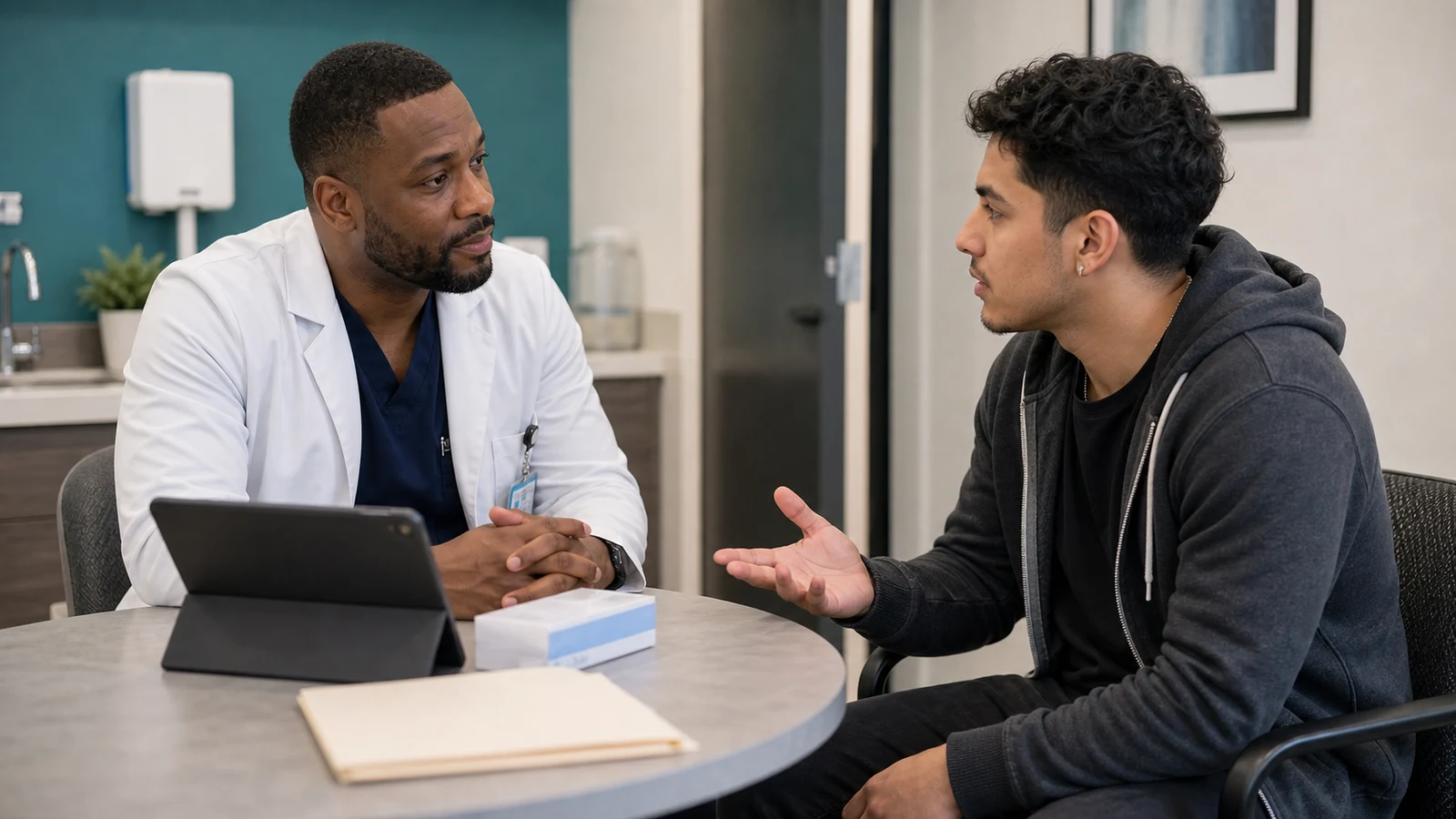
Walking into a clinic for PrEP can feel intimidating, especially if you have never discussed your sexual health openly with a provider. Here is exactly what happens at Moses Medical, step by step:
1. Confidential intake. You check in at the front desk like any other appointment. Your reason for the visit is private — it will not be announced or displayed. If you prefer, you can book online and simply note “PrEP consultation.”
2. Brief history and risk assessment. Your provider will ask about your sexual history, partners, condom use, and any prior STI diagnoses. This is a clinical conversation, not a moral evaluation. We ask these questions because we need accurate information to keep you safe.
3. Baseline lab work. Before starting PrEP, we need to confirm that you are HIV-negative, check your kidney function, and screen for hepatitis B and other STIs. All of this bloodwork is done in our on-site lab during the same visit — you do not need a separate lab appointment.
4. Medication selection. Based on your lab results, health history, and preferences, we will discuss whether Truvada, Descovy, or injectable Apretude is the best fit. If you choose the injectable, your first two doses are given four weeks apart, then every two months after that.
5. Prescription and follow-up scheduling. You leave with either a prescription in hand or, for the injectable, your first dose administered on-site. Follow-up visits are scheduled every three months.
The entire first visit typically takes 45 to 60 minutes. Every visit after that is shorter.
What Medicaid Covers
Let me be direct: if you have Medicaid in New York State, PrEP costs you nothing. Zero copay for the medication. Zero copay for the required lab work. Zero copay for the quarterly follow-up visits.
This applies to MetroPlus, Fidelis Care, Amerigroup, WellCare, Molina, United Healthcare Community Plan, and all other Medicaid managed care plans we accept at Moses Medical. For a full breakdown of what each plan covers and how referrals work, see our Medicaid coverage guide.
If you do not have Medicaid but are uninsured or underinsured, the federal Ready, Set, PrEP program provides PrEP medications at no cost, and manufacturer patient assistance programs can cover lab and visit costs. Our front desk team can walk you through eligibility in minutes.
The cost barrier does not exist. If someone tells you PrEP is too expensive, they either do not know the current landscape or they are not trying hard enough.
Multilingual, Culturally Competent Care
The Bronx is home to one of the largest Haitian and Francophone African communities in the United States. Many of these residents face a double barrier to PrEP access: the general stigma around HIV prevention, compounded by cultural taboos around discussing sexual health.
At Moses Medical, our team speaks English, Spanish, Bangla, and Hindi. We understand that trust is built in your language, not just in your insurance network.
Our behavioral health team, led by Dr. Emmanuel Okafor, is available if you need support processing the emotional or relational dimensions of starting PrEP. Dr. Okafor has written about the barriers to mental health care in the Bronx and how our behavioral health team addresses stigma, language, and access. Starting a medication that protects you from HIV can bring up feelings about identity, relationships, and community. You do not have to navigate that alone.
Common Questions I Hear
“Does PrEP protect against other STIs?” No. PrEP prevents HIV only. We still recommend condoms for protection against gonorrhea, chlamydia, syphilis, and other infections. Your quarterly visits include STI screening so we catch anything early.
“Will PrEP show up on my insurance explanation of benefits?” Medicaid EOBs do list services, but they use clinical codes, not plain-language descriptions. If privacy is a concern, talk to us — we can help you understand what will and will not appear on any documents.
“Can I stop and start PrEP?” Yes. PrEP is not a lifetime commitment. If your risk changes — for example, you enter a monogamous relationship — you can discontinue with your provider’s guidance. If your circumstances change again, you can restart.
“Are there side effects?” Most patients tolerate PrEP well. Some experience mild nausea, headache, or fatigue in the first few weeks, which typically resolves. Kidney function is monitored at every quarterly visit as a precaution.
Take the Step
HIV is preventable. Not theoretically, not in a clinical trial — preventable right now, for you, at no cost. The only thing standing between most eligible people and PrEP is a single conversation with a provider who will not judge them. If this is your first time visiting Moses Medical, here is a step-by-step guide to your first visit so you know exactly what to expect.
Moses Medical is at 871B Westchester Ave, Bronx, NY 10459 — near the Simpson Street stop on the 2 and 5 trains. You can book a confidential PrEP consultation online or call us at (646) 741-2111. Walk-ins are welcome. No referral needed.